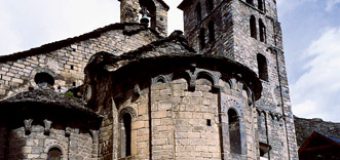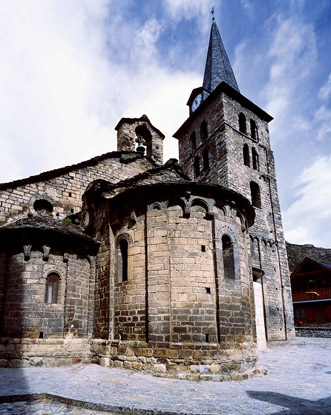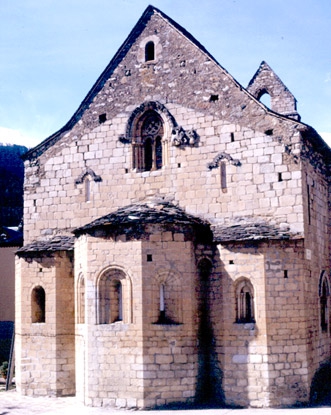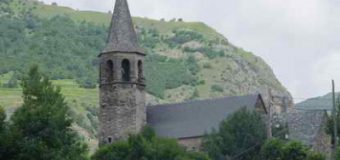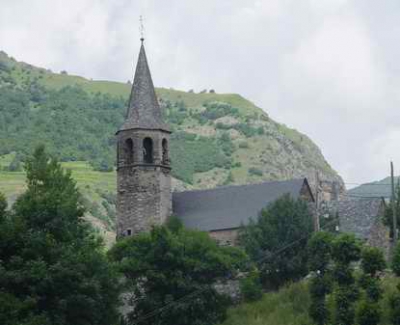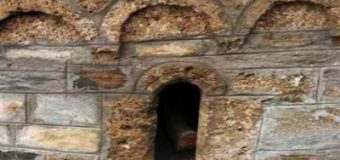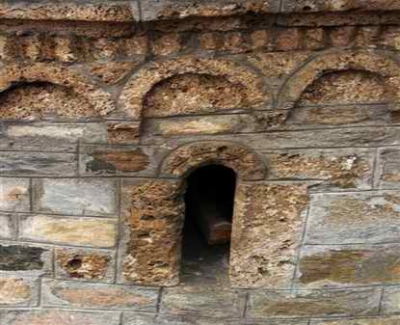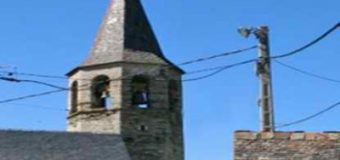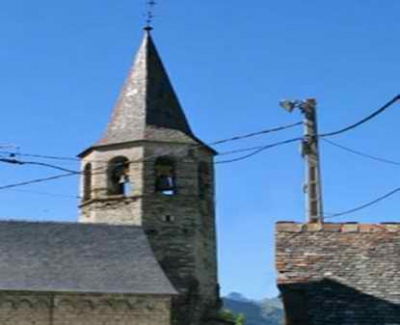
Sant Tomàs de Casarilh

Tiype: Church
Century: XII-XVII
Architectural style: Romanesque-Popular
Village: Casarilh
Municipality: Vielha e Mijaran

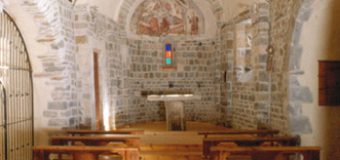
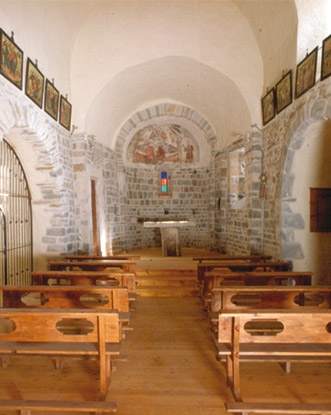
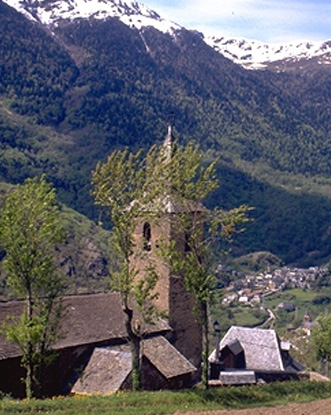
The church of Saint Tomàs has one small interior nave covered with a wooden vault quite reformed, but with a semi-circular Romanesque abside.

There is a Renaissance baptismal font supported by a Romanesque pedestal and a noteable Romanesque Christ from the 12th – 17th centuries.

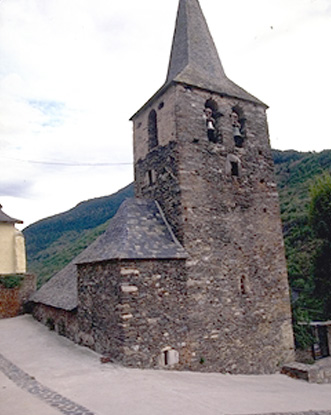
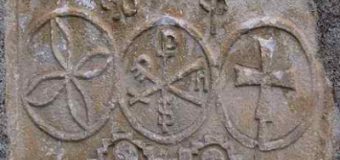
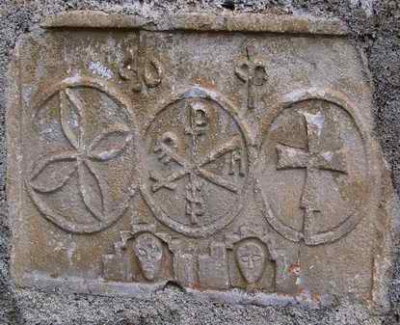
Near the portal of the bell tower there is an interesting white marble sepuchral tombstone from the Paleocristian epoch with a beautiful monogram of Christ on it embedded in the wall.

A part of this church is conserved in the Museum of the Valle de Aran.
Era Mair de Diu dera Purificacion

Type: Church
Century: XII
Architectural style: Romanesque
Village: Bossòst
Municipality: Bossòst

Bossòst, one of the most dynamic and colouristic villages of the Baish (Low) Aran, houses a magnificent example of Aranese Romanesque architecture: the church of Era Mair de Diu dera Purificacion. It stands near the boulevard that crosses the village, facing the old neighbourhood of el Cap dera Vila.
What is immediately striking about its magnificent architecture is its stylistic unity, which makes it a faithful visual documentation of Romanesque architecture as it evolved in the 12th Century. Era Mair de Diu dera Purificacion is a compendium of the main attributes of the artistic legacy of the Romanesque, with its three-nave basilical ground plan built in a barrel vault and resting on circular pillars; its three apses, profusely decorated with Lombardy origin sculptural elements; its belfry, attached to the north-east angle comprising decorative columns, bell-shaped and geminated windows and Lombardy arcuatures, and its two facades, each one with a tympanum, of major iconographic and structural richness on the basis of a succession of decreasing arches.
Inside the church, the structural design of the Romanesque architecture of Era Mair de Diu dera Purificacion will be apparent, with the four arches that separate the naves and the supporting circular pillars, all of them made of finely-worked and squared stone, crowned by smooth imposts. One detail not to be overlooked is a wall painting fragment in the central apse, which points to the representation of the Epiphany; these paintings date back to the end of the 13th Century and the beginning of the 14th.

Sant Estèue de Betren

Type:Church
Century: XIII-XIV
Architecturalstyle: Romanesque – Gothic
Village: Betren
Municipality: Vielha e Mijaran

The first historical references to the church of Sant Estèue de Betren date from the 14th Century, at the dawn of Gothic art, as is shown by the coexistence of Romanesque and Gothic styles in the architectural and sculptural configuration of the church. The absidal space and the facade of Sant Estèue are the two areas which best evince this transition from Romanesque to Gothic. The head of the church is based on three polygonal apses, the central one with five faces and the side ones, with three, where the respective windows are located and semicircular arches alternate with gothic arches; above the central apse there is a patently Gothic window flanked, on the other hand, by two Romanesque loophole windows.
The access facade, one of the church’s artistic reference points, opens in the north wall, and originally constituted a new conception in facades; stylistically it is a breakthrough from the narrative and naturalist language of the Gothic culture; so much so that in the facade’s decreasing arches we can ‘read’ the biblical episode of the Final Judgement with the representation of the condemned counter-posed to the chosen; the Virgin, with the Child Jesus in her lap, overlooks the scene from above.
At the top of the west wall there is a two-floor belfry; the inside of the church still houses a font of holy water, which probably dates from around the 16th-17th Centuries, supported by a Romanesque column.

Sant Pèir de Betlan

Type: Church
Century:  XII,XVII-XVIII
Archictectural Style: Romanesque-Baroque
Village: Betlan
Municipality: Vielha e Mijaran

The church of Sant Pèir de Betlan has a single barrel-vaulted nave, crowned to the east by a huge apse and flanked to the west by a belfry. The recent restoration of the building has made it possible to piece together the sequence in which it was built, mainly in two periods: the 12th and 13th centuries (the ground plan, peripheral walls, apse, baptismal font and Virgin of the Snows) and the 16th and 18th centuries (the chapel, wall paintings, religious sculptures and the belfry).The Romanesque origins of the church of Sant Pèir can also be appreciated in the exterior decoration of the apse, in the building’s ground plan configuration and, above all, in the 13th century baptismal font. The religious sculpture of the Virgin of the Snows is outstanding. In the phase between the 16th and 18th centuries, the church underwent major transformations which are patent in the lifting of the nave, the subsequent addition of the sub-arches and the building of the side chapels. The wall paintings date back to the 16th and 17th centuries. Finally, there are three Baroque religious sculptures from the 18th century.

Sant Martin de Benòs

Type: Church
Century: XII-XVIII
Architectural style:Baroque
Village: Benòs
Municipality: Es Bòrdes

The church is Romanesque building, the XII century, although few traces remain. It is rectangular with a single nave with barrel vault with aisles added in the sixteenth century, three sections with formeros and arches. Keep a processional cruxz. The bell tower is a square tower with pointed slate roof.

Sant Ròc de Begòs

Type:Church
Century: XII, XIV, XVII
Architectural style:Romanesque, Gothic, Baroque
Village: Begòs
Municipality: Es Bòrdes

This church is dedicated to Sant Ròc is very popular in the valley. It is of Romanesque origin and very small.

The bell tower of the church is squared with a pointed covering of slate.

There is a divided nave in three sections by transversal arches holding up the pointed vault. In the 14th century two side chapels were added. As a result they make up the shape of Greek cross.

It conserves a baptismal font and another for the Romanesque blessed water as well as some polychromed carvings from the 17th century.

Sant Pèir ad Víncula de Bausen

Type:Church
Century: XVIII
Architectural style: Baroque
Village: Bausen
Municipality: Bausen

The parrochial church is dedicated to Sant Pèir ad Vincula. It is a buidling of modern construction from the beginning of the 18th century. The doved Renaissance door is one of the more notworthy elements of the church dating to 1709. It has a nave covered by a barreled vault and a square sanctuarly. To the left of the entrance door there is a inserted fragment of a marble Romanesque cinerary pillar with three low arch busts.

Sant Feliu de Bagergue

Type: Church
Century: XII-XIII Y XVIII
Architectural Style: Romanesque – Baroque
Village: Bagergue
Municipality: Naut Aran

The church of Sant Feliu comes from the primitive Romanesque period with diverse restorations and an addition in 1524.

The western door is formed of three arched vaults in degradation exteriorly framed by a powder guard with checkered molding. The bell tower, exempt, has a square base and pyramidal covering.

It has a nave which had a barrel vault wtih two chapels per side. It conserves the former arches. The altar stone is an ancient rock block decorated in the pre-Roman period. There is a chapel of the sanctuary which venerated the Renaissance image of the Virgin.

Sant Joan d’Arròs e Vila

Type: Chapel
Century: XI, XVII
Architectural Style: Romanesque – Renaissance
Village: Arròs
Municipality: Vielha e Mijaran

Chapel of S. XI-XVII, of Lombard Romanesque and Renaissance styles, at the foot of pistes linking Vilamòs with the Valley of Varradòs.

This sanctuary of the peoples of Arròs and Vila is located in a charming place located on the beautiful valley of Varrados. The initial romanesque building of a single nave covered by a barrel vault and finished to the east by a semicircular apse with Lombard blind arcades and sawtooth frieze, was subsequently extended westward extending the ship and built some outbuildings.

Mare de Diu deth Rosèr d' Aubèrt

Type: Church
Century: XII, XVIII
Architectural Style: Romanesque-Baroque
Village: Aubèrt
Municipality: Vielha e Mijaran

This church was built in the 12th century and has had many modifications over the years. In the 16th century a bell tower with squared structure was added with a second octoganol body which had a marbel Roman pillar inserted in an angle. The rectangular nave with three sections separated by pillars and a half point transversal arch and with barelled vaults. It has conserved a baptismal font and a Gothic style processional cross which is one of the best kept of the valley