The wool factory of Vielha is a representative example of the small textile industries that emerged halfway through the 19th Century on both sides of the central Pyrenees.
The factory was built at the end of the 11th Century by Rafael Portolés Lafuste (1858-1936), a resident of Vielha, who had learnt the trade as an apprentice in Miremont de Comenge (France), where his mother’s family hailed from.
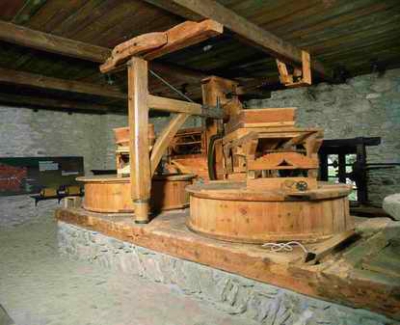
The industry used the energy generated by the river Nere. The water was captured and conducted through an external canal to a wooden wheel. The latter was connected in turn to a long axle, also external, which held the gear assembly of the machinery and transmitted the energy generated by the water.
Jusèp Portolés Fontà (1904-1987), son and heir of Rafael Portolés Lafuste, continued the factory activity, and made his living solely from the industry.
Wool-making was maintained until the floods of 1963 destroyed the factory’s outside canal yet again. Thereafter, the machinery was powered by electricity. However, production fell away progressively until the factory had to close down in the seventies.
Since then, it has withstood the passage of time and development speculation thanks to the stubbornness of a person who has a sentimental bond with the factory, Ms. Isabel Vidal, the widow of Jusèp Portolés Fontà.
In 1999, the Conselh Generau dera Val d’Aran decided to purchase and restore this interesting piece of heritage to turn it into a kind of living testimony to the contemporary history of the Aran Valley
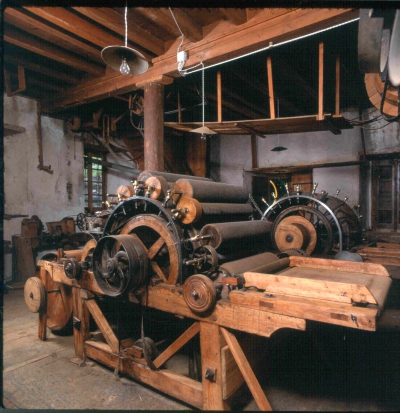
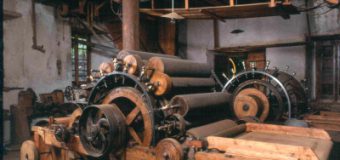
The plant machinery was used to turn the natural wool into yarn that could be manually knitted. The inhabitants of the valley used to take the wool, clean and dry, to the factory. The balls were weighed on scales and the number of skeins and the thickness of the yarn was agreed to. The first stage of the transformation process, involving three machines, was performed on the ground floor of the factory.
Firstly, the devil or tiger stripped, opened and separated the balls of wool.
Subsequently, the opening card transformed the balls into a web which was often used to make quilts and mattresses.
Finally, the finisher card prepared the wool that was to be used to make yarn, dividing the web from the opening card into finer rovings, which were then rolled into small metal tubes.
The spinning process was completed in the factory attic, with the help of another three machines:
– The mule-jenny, which first drew and twisted the yarn and then rolled it onto the spindle after a pause. This machine was operated by one person. The operator had to pay great attention, since if a piece of yarn snapped the machine had to be stopped immediately to avoid ruining the whole process.
– The twister was used to twist the yarn and roll it onto a bobbin, cone or spindle, depending on the amount of yarn and thickness required.
– The skein-making machine completed the process, giving the final twist to the yarn and making up the skeins. An iron bar was used for this operation, nailed to one of the rafter on the ceiling, and made it easier to twist the skeins.
Winter Timetable ( from december 2d 2011 to april 8th 2012)
Guided tours on Wednesday and friday at 12:00
Price: 1,50 euros.
More Information:
MUSÈU DERA VAL D’ARAN
Tel. 973 641815
E-mail: info.museu@aran.org