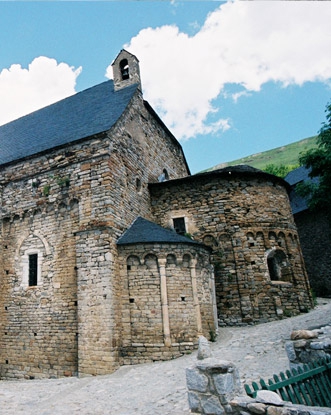
Museu eth Corrau, Bagergue

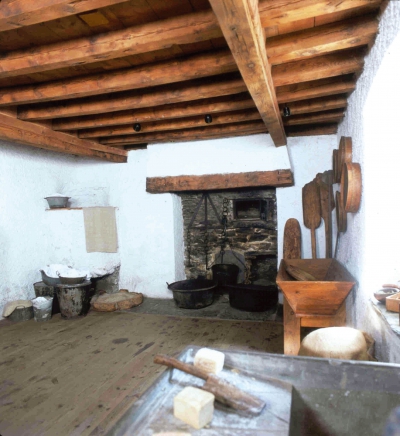
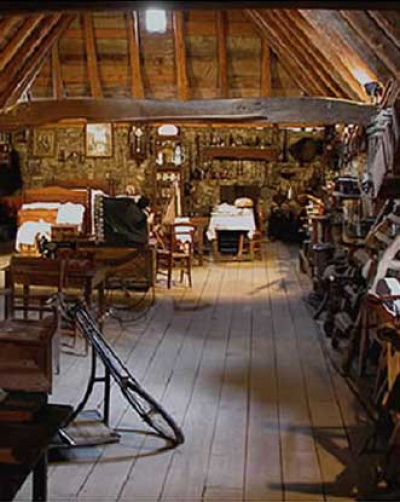
“ETH CORRAU” is something unique. It is an example and an exposition of things and objects that define a culture, its traditions, the work life and the old arts and crafts.

In “ETH CORRAU” there are interesting and exclusive items with all types of old and valuable objects from hundreds of years ago. There is a grand cultural and historical value in the more than 2500 pieces on display.

If you visit “ETH CORRAU” you will leave convinced that you have lived 500 years ago.

For more information and to consult timetable: 973 640193
Musèu dera Nhèu,Unha

The museum consists of four sections:

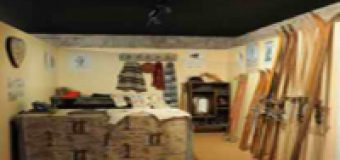
SNOW IS: What is snow?, Crystals and cohesion of the snow, avalanches, glaciers, the adaptation of animals to the snow.

WHEN THE SNOW WAS SUFFERED: A valley closed by snow, winter activities, an architecture adapted, clothing, legends and folk beliefs, popular sayings.

SNOW SPORTS: The beginnings of skiing in the Valle de Aran, various forms of snow sports, Aran Olympic athletes, Winter sports and fashion.

SKI RESORTS: History of the ski resorts in the world, from Catalonia, and the Val d’Aran. Audiovisual: Baqueira in space and time. Snow professions.

ADDRESS: Calle Santa Eulalia, 17-19 UNHA

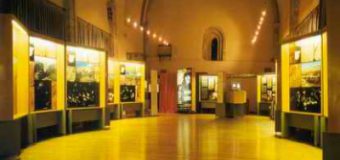
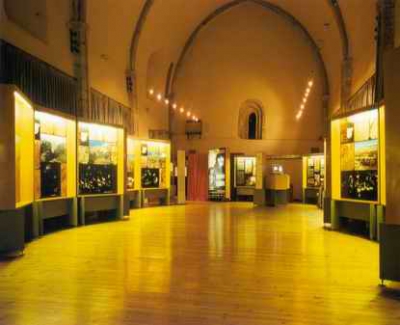
Glèsia de Sant Joan d'Arties

Temporary exhibitions space .
Direction: Crta de Baqueira, s/n ARTIES
Phone Number: 973 64 18 15

Winter hours:
Monday to Saturday from 17 to 20 hours.
Price: Free.

More information:

MUSÈU DERA VAL D’ARAN
Carrer Major, 26 – Vielha
Tel. 973 641815
E-mail: info.museu@aran.org

Ecomusèu Çò de Joanchiquet, Vilamòs

Ecomusèu çò de Joanchiquet is in Major Street, in Vilamòs, one othe the Aranese villages which best keeps the traditional architecture of the valley. Joanchiquet stands for the prototypical traditional Aranese house; the so-called ‘auviatge’. An ‘auviatge’ consists of a group of bulidings –a house, ‘bordas’ (cattle sheds), a pigeon loft and a pigsty-. These buildings are organized around an enclosed courtyard, where there are a vegetable garden (casau) and a little orchard (vergèr).
With the restoration of the house, both the furniture and the inner layout from the end of the 20th Century have been kept. When one visits Joanchiquet, one travels back to the past and discovers the daily life of its history.

More information and reservations:

MUSÈU DERA VAL D’ARAN
Tel. 973 641815
E-mail: info.museu@aran.org

Sant Miquèu de Vilamòs

Type: Chapel
Century: XI
Architectural sytle: Romanesque Lombard
Village: Vilamòs
Municipality: Vilamòs

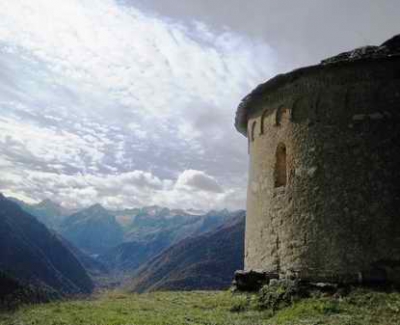
Chapel of the XI century, built in Lombard Romanesque style, 15 min. walk from the town of Vilamòs.

This is a small Romanesque building situated on a promontory from which you get magnificent views over the Garonne river, the Artiga Lin, and Aneto massif.
According to tradition, in this place had existed a village, considered the oldest in the valley.
It has a single nave with a barrel vault, under a gabled roof, composed of large slabs. To the east the building finishes with a semicircular apse decorated with blind arcades lombard style, and a freeze of saw teeth. The walls retain the original lime revoked.

Santa Maria de Vilamòs

Type: Church
Century: XI-XII, XVIII
Architectural style: Romanesque – Neoclassic
Vielha: Vilamòs
Municipality: Vilamòs

The church of Santa María de Vilamòs has a three-nave basilical ground plan; the central nave and the south side are barrel vaulted; the north lateral vault is a quarter sphere; the whole structure rests on circular pillars finished off by a smooth impost. The last restoration work carried out uncovered the configuration of the inside masonry of the building, with an ordered layout of the ashlars, a very Romanesque trait.
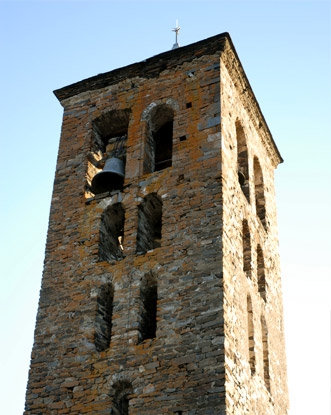
The belfry of the church is attached to the centre of the south wall, and which, along with that of the church of Bossòst, are the only two Romanesque belfries conserved in the Aran Valley. The layout of the openings and decorative elements of the belfry of Vilamòs are totally Romanesque, as endorsed by the semicircular arched windows and the decorative columns that run along the body of the tower.
The absidal head was added in the Gothic period, and the original Romanesque apse was replaced with a polygonal one. The access door to the temple, originally located in the south wall, is now in the west wall and dates from modern times (1816).
One of the most interesting artistic attractions of the church of Santa María of Vilamòs are the Roman gravestones embedded into different wall parts, although those located in the belfry tower, which can be seen from the outside, are particularly noteworthy.

Sant Fèlix de Vilac

Type: Church
Century: XII, XIV, XIX
Architectural style: Romanesque-Gothic-Neoclasico
Village: Vilac
Municipality: Vielha e Mijaran

The church of Sant Fèlix will be a delight to the visitor’s artistic sensitivity; its architectural configuration, with its basilical ground plan, reveals its Romanesque origin; this constitutes a structure of three naves (the central nave has a barrel vault and the side naves a quarter sphere) with the four arcades that separate the naves and the corresponding circular pillars supporting it.
But the Sant Fèlix’s finest Romanesque epoch architectural and sculptural reference is its facade; it is formed by four semicircular decreasing arches, protected by a decorative dust-guard with the typical chequering (which originated in Aragon and Navarre). The tympanum boasts a curious sculptural unit with the representation of the figure of Christ, crowned and enthroned, surrounded by the Tetramorph; another outstanding element is the tombstone (funeral origin) embedded at the top of the facade.
The Gothic heritance is patent in the construction of the belfry, which dates from the 14th and 15th Centuries; it is attached to the west wall of the church, and its base might suggest a certain defensive origin.

News: Bell tower visited by reservation!

Sant Miquèu de Vielha

Type: Church
Century: XIII-XV,XVIII
Architectural style: Romanesque-Gothic-Renaissance
Village: Vielha
Municipality: Vielha e Mijaran

The first thing that the visitor’s eye catches on gazing at the outside of the church of Sant Miquèu is its stunning belfry (16th Century), set on a facade in a narthex; the same architectural solution can be seen in the church of Sant Martin de Gausac.
The facade, which dates from the turn of the 13th and 14th Centuries, bears faithful witness to the artistic evolution of the Romanesque language towards the early Gothic forms (the same reference is to be found on the facade of the church of Sant Estèue de Betren); it is structured on five decreasing arches which illustrate different biblical episodes on the basis of anthropomorphic sculptural elements.Before entering the church the visitor’s eye will be caught by the ancient tympanum that decorates the original Romanesque facade and which is now embedded in the west wall next to the entrance door; there is also the typical representation of the Romanesque Christ Crucified, wearing a knee-length tunic (perizonium), and in a frontal and prone position. Once inside the religious building, we come upon the striking baptismal font with an iconography of vegetal motifs sculpted in relief, a very common trait in 13th-Century Aran valley fonts.
The Gothic altarpiece which decorates the central apse, attributed to the Master of Vielha, stands out at the back of the nave. There is however no doubt that the most emblematic piece of the church of Sant Miquèu is a Romanesque sculpture of Christ (Crist de Mijaran) which formed part of a greater sculptural ensemble, the fruit of the mature period of the workshop of Erill-la-Vall, and which is one of the most paradigmatic pieces of 12th-Century Romanesque sculpture.

Santa Eulària d’Unha

Type:Church
Century: XII, XVI,XVIII
Architectural Style: Romanesque-Gothic-Renaissance
Village: Unha
Municipality: Naut Aran

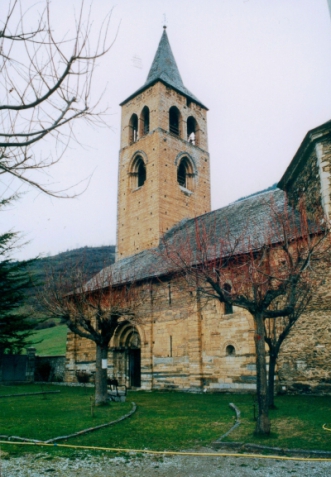
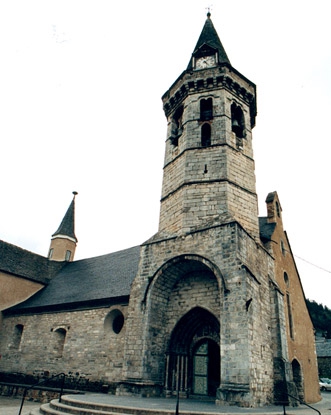
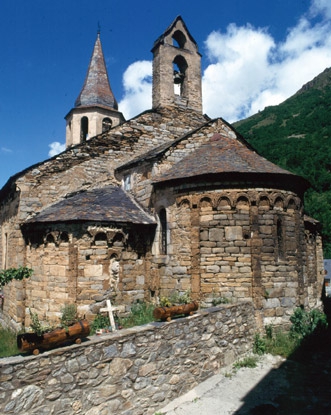
Santa Eulària de Unha is a church of Romanesque origin, faithful to the architectural configuration of the period, with its basilical three-nave ground plan, the central one with semicircular vault and the side naves with quarter sphere; to the East, three apses decorated in the Lombardy style; finally a belfry was added in the NW angle in the 18th Century.
To begin with, the church of Unha is the only church in the Aran Valley which conserves its Romanesque wall paintings, located in the semi-sphere of the central apse. These paintings have fragments of what the figure of the Pantocrator would have been (the face is conserved) located in the mandorla and surrounded by the Tetramorph.
The presence of wall paintings does not finish here; paintings from the 16th Century were recently discovered and restored, sequentially depicting the biblical episodes of Jesus praying in the Garden of Gethsemane, Judas’ kiss, the scourging, Pontius Pilate washing his hands, the road to Calvary, the Crucifixion and the Final Judgement with Christ Glorified.
The Romanesque legacy of the church of Santa Eulària can also be appreciated through the presence of its baptismal fonts. Of the two it conserves, one is a plunging-type baptismal font, and might have been a reused sarcophagus. The other baptismal font, with basin and support leg, reproduces the same archaism and decoration motifs.

Santa Maria de Cap d’Aran de Tredòs

Type:Church
Century: XI-XIII
Architectural Style:Roman
Village: Tredòs
Municipality: Naut Aran

The architectural configuration of the church of Cap d’Aran follows the principles of Romanesque architecture, namely a three-nave basilical ground plan with a barrel vault headed by three apses; the last restoration work on the church revealed the different building stages involved. In fact, the roof appears to have collapsed at least twice. Another detail which brings this succession of structural collapses to light is the continual reuse of building materials, which is noticeable in certain areas such as the windows, facade and apse. The church of Santa Maria de Cap d’Aran de Tredòs features two unusual characteristics versus the rest of the ecclesiastic heritage of the Aran Valley: the presence of a crypt at the bottom of the altar and the siting of the belfry, removed from the actual religious building. The crypt comprises two areas, one rectangular and the other semicircular, separated by a semicircular arch. As far as the belfry is concerned, and although it contains the beginning of what was possibly the original Romanesque belfry, the rest of the body of the building is composed of add-ons from later periods. Finally, it should be mentioned that the church of Cap d’Aran had Romanesque wall paintings which are attributed to the circle of the Master of Pedret in 11th and 12th Centuries. These paintings were forcibly removed and taken out of the Aran Valley; they can now be seen in The Cloisters Museum of New York.